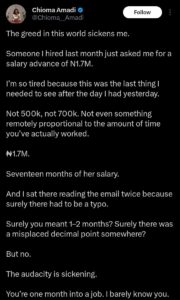
An employer has sparked widespread debate online after sharing an experience with a newly hired staff member who requested a ₦1.7 million salary advance just one month into the job — an amount equivalent to nearly 17 months of the employee’s pay.
Employer expresses shock over request
The employer described the request as both surprising and concerning, saying it reflects what he believes is a growing sense of entitlement in the workplace.
Recounting the incident, he said he initially thought the email contained a mistake.
“I sat there reading the email twice because surely there had to be a typo. Not ₦500k, not ₦700k — ₦1.7m.”
According to him, the employee had barely spent a month in the role and was still undergoing the basic evaluation process.
“We’re still at the stage where I’m trying to see if you even understand the role you were hired for,” he added.
Concerns about professional boundaries
The employer questioned how a newly hired worker could expect the company to function like a personal credit facility.
“You’re one month into a job. I barely know you. And somehow, in your mind, the most reasonable thing to do is to ask your employer to bankroll the next year and a half of your life,” he said.
He explained that requests of this nature can undermine trust and create tension within employer-employee relationships.
Reflections on work culture
The employer also revealed that he spoke with several older business owners after the incident, and many of them said they had experienced similar situations. This, he said, further reinforced his concerns about professionalism and workplace discipline.
He added that after widening his recruitment pool to include foreign talent, he noticed fewer occurrences of such requests.
“Discipline, restraint, and professional boundaries shouldn’t be things you have to teach adults,” he said, noting that experiences like this often make business founders more cautious over time.
The story has since sparked mixed reactions online. While some people sympathised with the employer and supported his stance, others argued that situations like this highlight the need for stronger employee support systems in the workplace.
Check the post below…