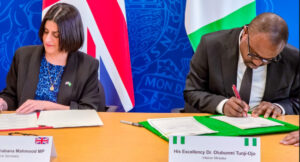
The Nigerian government has dismissed claims that a recently signed migration agreement with the United Kingdom would lead to the transfer of foreign criminals into Nigeria.
The clarification was made by the Minister of Interior, Olubunmi Tunji‑Ojo, who addressed public concerns over the contents of the pact, stressing that the deal does not target foreign prisoners or criminals, but focuses solely on Nigerian nationals who are out of status in the UK.
What the Agreement Actually Covers
Speaking on Channels Television’s Politics Today programme on Tuesday, Tunji‑Ojo explained that Article 7 of the migration deal centres on the dignified return of Nigerian citizens who no longer have the right to remain in the United Kingdom.
“What this agreement talks about are Nigerians who are overstayers or who are out of status in the United Kingdom,” the minister said.
He strongly refuted social media claims suggesting that the UK could send inmates or “dump criminals” in Nigeria under the arrangement.
“This government is not going to tolerate something like that,” Tunji‑Ojo stressed. “There is no way this government, under this president, will sign that sort of agreement; it’s never going to be done.”
 Misconceptions and Public Reaction
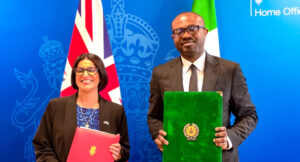
The migration agreement — signed during President Bola Ahmed Tinubu’s recent state visit to the UK — attracted criticism online, with some users misinterpreting its provisions as a pathway for Britain to transfer convicted criminals to Nigeria.
Tunji‑Ojo clarified that those reports were misunderstandings of the pact’s actual intent, which is to strengthen bilateral cooperation on migration management, border security, and economic development, not to shift criminal populations.
Transparency and Mutual Benefits
The minister emphasised that the government has been transparent about the deal, even though the full text is not yet publicly published. He noted that a detailed press release by the Presidential Spokesperson, Bayo Onanuga, outlined the agreement’s main sections.
Tunji‑Ojo also highlighted Article 8, which speaks to the rights of returnees, affirming that Nigerians coming back under the agreement will be treated with dignity and in line with their fundamental human rights.
“These agreements are based on the international diplomatic model of reciprocity,” he said, adding that the arrangement is a 50‑50 partnership between Nigeria and the UK.
Not the Same as the Rwanda Plan
Addressing comparisons with the controversial Rwanda asylum plan, the minister clarified that the Nigeria‑UK migration pact is fundamentally different. It does not involve third‑country relocation, does not include family members by default, and each return case will be handled under clearly defined legal conditions.
Global Migration Is a Shared Challenge
Tunji‑Ojo reminded Nigerians that irregular migration is not a problem unique to the UK or the US, but a global issue requiring cooperation.
“Partnership is needed to bring all hands together to solve this problem,” he said, affirming that Nigeria is committed to addressing migration challenges constructively, not exporting its own problems abroad.
➡️ Check Video for more🎥
https://youtu.be/3tdTKEqk4Eo?si=tFRwfHOtu5AvNrUE