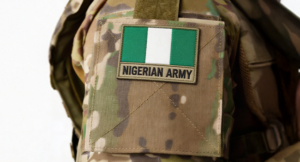
A former commander of Operation Safe Haven, Major General Henry Ayoola (rtd), has pushed back strongly against growing claims that Nigerian soldiers are forced to buy their own military kits due to systemic failure.
His reaction follows a viral interview by ex-soldier Rotimi Olamilekan, popularly known as Soja Boi, who alleged that many personnel spend their personal money on uniforms, boots, and even protective gear despite earning modest salaries.
But speaking during a televised interview, Ayoola dismissed the narrative as misleading.
According to him, every soldier in the Nigerian Armed Forces is already entitled to a complete set of standard-issue equipment, stressing that the system still provides what is required for operations.
He explained that what many people see as a “problem” is often a matter of personal choice, as some soldiers decide to upgrade or customise their kits for comfort, convenience, or efficiency.
“If a soldier chooses to improve their kit beyond what is issued, it shouldn’t be seen as a failure of the system,” he said.
Ayoola further clarified that there is a minimum requirement—known within the military as a standard kit level—that must be met before any soldier is deployed.
Addressing concerns about equipment shortages in certain operations, he admitted that challenges can occur, but noted that commanders often adapt by managing available resources and applying field innovations.
Meanwhile, the Nigerian Army has also denied claims that soldiers are left to fund their own gear, describing such reports as false and misleading.
In a separate statement, military authorities insisted that no personnel is sent into operational zones without the necessary protective equipment.
⚠️ BEYOND THE EQUIPMENT DEBATE
Interestingly, Ayoola shifted the conversation beyond uniforms and gear, arguing that Nigeria’s insecurity problem runs much deeper than what many assume.
According to him, the country is dealing with more than just a military issue—it is a complex struggle tied to power, ideology, and global influences.
He warned that without properly identifying the real enemy and understanding the root cause of the crisis, efforts to tackle insecurity may continue to fall short.
“You cannot solve a problem you have not clearly defined,” he said.
He also highlighted the increasing use of modern tools like surveillance drones in military operations, aimed at improving intelligence gathering and reducing ambush risks.