“Is Love a Contract? Man Sues After Funding University Education for Woman Who Won’t Marry Him.”

A young Nigerian man has sparked widespread debate after reportedly taking his ex-girlfriend to court for refusing to marry him—despite sponsoring her university education.
The case, which surfaced on Facebook through Obasi Nzubechi, has since ignited conversations about love, expectations, and the legal limits of personal promises.
How it all began
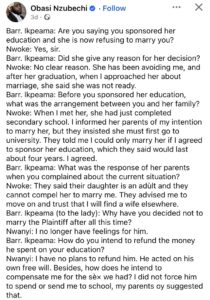
According to the man, their relationship started shortly after the lady finished secondary school. With intentions of marriage, he approached her family, but they insisted she must first obtain a university degree.
He claimed her parents agreed to the union on one condition—that he would take full responsibility for funding her education, a commitment expected to last about four years. Confident in their future together, he agreed.
A sudden change after graduation
However, things reportedly took a different turn after she completed her studies. When he brought up marriage, she declined, stating she was not ready.
He further alleged that she became distant and avoided further discussions. When he approached her parents again, they reportedly told him their daughter was now an adult who could make her own decisions—and advised him to move on.
Her side of the story
In her response, the lady reportedly stated that she no longer had feelings for him and had no intention of getting married.
On the issue of refunding the money spent on her education, she maintained that she owed him nothing. According to her, he made those decisions willingly. She also argued that their relationship was mutual, raising questions about how personal aspects of their past would be accounted for.
Court steps in
The matter eventually made its way to court, where the presiding judge delivered a firm and nuanced ruling.
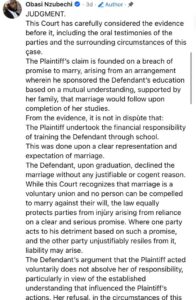
While emphasizing that no one can be forced into marriage, the court held that the circumstances surrounding the agreement could not be ignored. According to the judgment, the man’s financial commitment was based on a clear expectation of marriage.
The court ruled that her refusal, without strong justification, resulted in both financial and emotional loss to the man.
The verdict
In a decisive outcome, the court ordered the woman to pay ₦15 million in damages to the plaintiff.
The judge noted that although the man acted voluntarily, the existence of a clear understanding between both parties made the situation legally binding to some extent.
Public reactions
The case has since stirred mixed reactions online. While some argue that love and marriage should never be transactional, others believe the ruling highlights the risks of making major financial commitments based on personal promises.
As the debate continues, the story raises deeper questions about trust, responsibility, and where the law draws the line in matters of the heart.