A Nigerian lady has sparked reactions online after narrating how she confronted officials at her younger brother’s school over an additional ₦2,000 POS charge attached to a ₦200,000 school fees payment.
According to her account, the incident occurred when she visited the school to pay her brother’s fees but was asked to pay an extra ₦2,000 as POS charges, which she strongly questioned.
She explained that the disagreement began after school officials insisted the payment had to be processed through a POS terminal allegedly owned by a staff member, despite her concerns about the additional fee.
The situation reportedly escalated when the vice principal maintained that the school’s official POS machine was not functional at the time.
Sharing her experience online, she said she found the request suspicious and demanded clarity before proceeding with the payment.
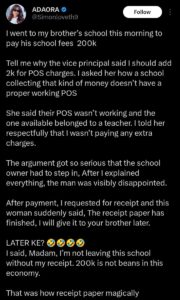
“I went to my brother’s school this morning to pay his school fees, ₦200k. Tell me why the vice principal said I should add ₦2k for POS charges,” she wrote. “I asked her how a school collecting that kind of money doesn’t have a proper working POS.”
She added that things became more tense after she requested an official receipt immediately after payment.
“After payment, I asked for receipt and the woman suddenly said, ‘The receipt paper has finished, I will give it to your brother later,’” she said. “I told her I was not leaving without my receipt. ₦200k is not beans in this economy.”
According to her, a receipt was eventually issued shortly after her insistence, despite earlier claims that the receipt paper had run out.
The story has since generated widespread reactions online, with many users praising her for insisting on transparency and accountability.
The incident has also reignited discussions about hidden charges, questionable POS fees, and poor financial transparency in some private schools across Nigeria.
Many commenters noted that while small service fees are common in some institutions, they should be clearly stated and properly documented to avoid distrust and disputes between parents and school authorities.