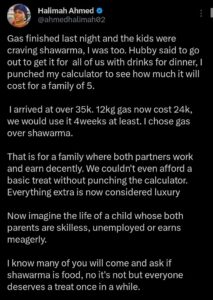
This story resonates with many households because it illustrates a common budgeting trade-off: choosing between an immediate treat and a longer-lasting household necessity.
Based on the woman’s account:
- Shawarma and drinks for a family of five would have cost more than ₦35,000 for a single meal.
- Refilling a 12kg cooking gas cylinder cost about ₦24,000.
- The gas would serve the family for roughly four weeks, making it a more practical use of the money.
From a household budgeting perspective, her choice reflects the concept of opportunity cost—spending money on one thing means giving up the chance to spend it on something else. In this case, the family gave up a one-time restaurant-style meal in favor of a utility that supports many meals over several weeks.
The story has generated discussion online because it highlights the impact of Nigeria’s rising cost of living. Many families are increasingly comparing short-term wants with essential expenses such as cooking gas, groceries, transportation, school fees, and electricity.
At the same time, reactions are likely to vary:
- Some people may see the decision as financially prudent and responsible.
- Others may argue that occasional treats are important for family bonding and morale, even during difficult economic periods.
- Many families try to balance both by finding lower-cost alternatives, such as making homemade versions of favorite foods.
Ultimately, the post reflects a reality many households face today: even when both parents are earning incomes, everyday spending decisions often require careful calculation and prioritization.