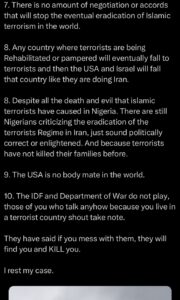
A man identified as @welcomekashami on X (formerly Twitter) has sparked widespread reactions after sharing what he called “10 hard lessons” drawn from the ongoing conflict involving Iran, the United States, and Israel.
In a lengthy post, he reflected on the actions of Iran, the international response, and broader geopolitical dynamics, drawing controversial conclusions about terrorism, global power, and international politics.
Key Takeaways from His Post
Terrorism and Negotiation
@welcomekashami argued that terrorist groups cannot be reformed or negotiated with. He claimed that such groups remain committed to violence and that conflicts with them only end through force, rather than diplomacy or rehabilitation. He also suggested that countries attempting neutrality out of fear are not necessarily safe from attacks.
Global Power Dynamics
The X user praised the military strength of the United States and Israel, arguing that recent events demonstrate their dominance on the global stage. He referenced critics who previously questioned U.S. military capability, suggesting that unfolding developments prove otherwise.
He summarized his perspective in a list of “10 hard lessons”:
-
Terrorists will rather die than change their ways.
-
You cannot rehabilitate or negotiate with terrorists; conflict ends only if you die or they die.
-
Terrorists may attack anyone, including those who have not provoked them.
-
Neutrality out of fear does not guarantee safety, as seen with the UK.
-
Critics who underestimated U.S. military power, like David Hundeyin, were proven wrong.
-
When terrorists face imminent defeat, they may target everyone around them.
-
Negotiations or accords cannot stop the eventual eradication of Islamic terrorism globally.
-
Countries that pamper or rehabilitate terrorists may eventually fall to them, prompting intervention from the U.S. and Israel.
-
Despite the destruction caused by terrorism in Nigeria, some continue to criticize military actions abroad for political correctness.
-
The U.S. and Israel are uncompromising in enforcing consequences on those who challenge them.
The post has ignited debate online, with some praising his analysis of global security, while others criticized it as overly simplistic or alarmist.
Watch the post below…