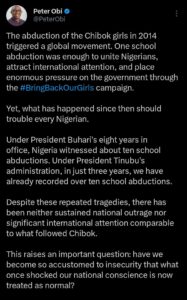
Former Labour Party presidential candidate, Peter Obi, has expressed concern over what he described as Nigeria’s growing desensitisation to school abductions, warning that repeated tragedies are no longer generating the level of outrage they once did.
Reflecting on the 2014 abduction of schoolgirls in Chibok, Obi recalled how the incident united Nigerians and drew global attention through the #BringBackOurGirls movement, placing pressure on authorities and demanding accountability at the highest levels.
From Chibok to the Present
Obi noted that during the administration of Muhammadu Buhari, Nigeria recorded about ten school abductions over an eight-year period. He argued that under the government of Bola Ahmed Tinubu, the country has already witnessed more than ten similar incidents within just three years.
According to him, the most troubling aspect is not only the frequency of the attacks but also the apparent silence that follows them. He observed that recent abductions have failed to spark the sustained public protests and international attention that followed the Chibok tragedy.
Obi questioned whether insecurity has become so commonplace that it no longer shocks the nation’s conscience, urging Nigerians to reflect on the growing normalisation of such incidents.
Call for Responsible Leadership
The former Anambra State governor criticised what he described as a political class that appears more focused on electoral calculations than on addressing insecurity, poverty, and the hardship facing millions of Nigerians.
He warned that continued failures in governance have damaged Nigeria’s image internationally, with some observers describing the country as a “now disgraced nation.”
Obi maintained that denial, propaganda, and political distractions would not solve the nation’s challenges. Instead, he called for leadership that is competent, compassionate, and accountable to the people.
Message to Young Nigerians
Addressing the youth, Obi urged them not to become indifferent to the country’s challenges.
“Young Nigerians, take back your country,” he said, reiterating his long-standing belief that “A New Nigeria is Possible.”
His remarks have since reignited conversations online about insecurity, leadership responsibility, and whether repeated tragedies have gradually made Nigerians less responsive to issues that once united the nation in collective outrage.