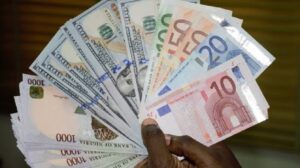
The Nigerian Naira closed the first full trading week of March 2026 on a relatively stable note against the US dollar, trading around ₦1,385/$ despite showing slight weakness during the period.
Data from the Nigerian Foreign Exchange Market (NFEM) and the parallel market indicate that the currency moved within a narrow range throughout the week.
Analysts say the Naira’s performance was supported by strong external reserves and easing inflationary pressure.
Official market performance (NFEM)
At the official NFEM window, the Naira opened Friday’s trading at ₦1,385.42 per dollar. By about 3:00 a.m. WAT, the rate had slightly strengthened to ₦1,385.20/$.
This followed the previous day’s closing rate of ₦1,385.30, suggesting the market is currently in a consolidation phase.
Compared to late February, when the Naira traded closer to the ₦1,360 range, the current rate reflects a mild week-on-week depreciation. However, market liquidity remains relatively stable.
Authorised dealers noted that the Central Bank of Nigeria (CBN) continues to operate the “willing-buyer, willing-seller” model, a system that has helped reduce the sharp intraday volatility previously experienced in the market.
Parallel market trends
In the parallel market, the dollar traded between ₦1,395 and ₦1,405 during the same period.
The gap between the official and parallel market rates remains relatively narrow, estimated at about 1.5 percent.
Currency traders in Lagos and Abuja said demand toward the end of the week mainly came from personal travel needs and small business transactions. They also noted that there are currently no signs of speculative hoarding.
The modest difference between both markets suggests that the central bank’s foreign exchange supply to Bureau De Change operators is helping to meet retail demand.
Macroeconomic factors and outlook
Several economic indicators are currently supporting the Naira.
Nigeria’s external reserves recently climbed to $50.45 billion, the highest level recorded in about 13 years. The reserves now provide roughly 9.68 months of import cover, strengthening the CBN’s capacity to stabilise the exchange rate.
Inflation has also shown signs of easing. Headline inflation fell to 15.10 percent in the latest report, a significant drop from the 34.19 percent peak recorded in 2024.
Another contributing factor is the operation of the Dangote Petroleum Refinery, which analysts say has helped absorb part of the impact of rising global crude oil prices. This reduces Nigeria’s demand for foreign exchange used in importing refined petroleum products.
Meanwhile, the country’s crude oil production remains steady at about 1.46 million barrels per day, ensuring a consistent flow of foreign exchange earnings.
Market analysts expect the Naira to close the week within the ₦1,380 to ₦1,390 range against the dollar.
Attention is now shifting to mid-month trade data, which could offer further insight into the impact of recent interest rate adjustments on the economy.