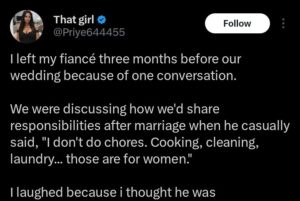
A woman has reportedly called off her wedding just three months before the ceremony after a conversation with her fiancé about marital responsibilities exposed fundamentally different expectations about marriage.
The incident, which has since sparked debate online, reportedly occurred in Nigeria while the couple were putting the finishing touches on their wedding plans.
A discussion that changed the relationship
According to the woman, the disagreement emerged during a casual conversation about how responsibilities would be shared after marriage.
She claimed her fiancé made it clear that household duties such as cooking, cleaning, and laundry were exclusively a woman’s responsibility, despite expecting his future wife to work full-time and contribute financially to the household.
“I laughed because I thought he was joking. He wasn’t,” she recalled.
“He wanted a woman who would work full-time, split bills, help raise the children, and still handle all the housework because that’s how it’s supposed to be.”
The woman said she became increasingly concerned by his expectations and decided to ask what responsibilities he believed would fall to him within the marriage.
According to her, his response was simply: “Providing leadership.”
Decision to walk away
The exchange prompted her to reconsider the future she was preparing to enter.
She said the conversation made her realise that their views on partnership, responsibility, and equality within marriage were fundamentally incompatible.
“That was the day I realised he didn’t want a partner; he wanted an employee,” she said.
“Marriage is hard enough without signing up to be someone’s unpaid domestic staff.”
Rather than proceed with a union she felt would place an unfair burden on her, the woman decided to end the engagement despite the wedding being only months away.
Debate over modern marriage roles
The story has reignited discussions about gender roles and expectations within marriage, particularly in a society where traditional and modern views often intersect.
Questions surrounding household responsibilities, financial contributions, and shared parenting have increasingly become topics of public debate, especially as more couples navigate dual-income households.
While some people criticised the woman’s decision and argued that compromises could have been reached, others praised her for addressing a major compatibility issue before marriage rather than after.
The incident has since generated widespread reactions online, with many Nigerians sharing their views on what constitutes a fair and balanced partnership in modern relationships.
Check out the post below.