Most people begin investing with a simple instinct: find something that goes up and put money into it. That approach can work in strong markets, but it often fails when conditions change. The real problem is not picking the wrong asset—it is building a portfolio without structure. When markets turn, a single concentrated position can erase months or even years of gains.
Diversification is often described as the solution, but it is more than simply owning many assets. True diversification means owning a mix of investments that do not all move in the same direction at the same time. This article breaks down practical ways beginners can build a portfolio that remains stable under pressure.
Start With Your Risk Profile, Not Your Assets
Before choosing any stock, bond, or fund, the most important question is simple: how much loss can you tolerate without panic-selling?
This answer determines how your portfolio should be structured.
There are generally three broad portfolio types:
- Conservative portfolio: Focuses on capital preservation. It is heavily weighted toward bonds, cash-like instruments, and gold. Returns are typically modest but relatively stable.
- Balanced portfolio: Splits exposure between equities and bonds. It offers moderate growth with moderate volatility.
- Aggressive portfolio: Heavily weighted toward equities (often 70% or more), including growth stocks and higher-risk assets. It offers higher long-term returns but also deeper drawdowns during market corrections.
Your time horizon also matters. Money needed in the short term should not be exposed to high volatility. A minimum horizon of around three years is often suggested for meaningful exposure to risk assets, as shorter periods increase the chance that market swings will dominate outcomes.
The Core Principle: Low Correlation Between Assets
Diversification only works when assets behave differently under the same conditions. Owning ten technology stocks, for example, is not true diversification—they often rise and fall together.
A stronger approach is combining assets with low or negative correlation:
- Stocks and bonds: During recessions or market downturns, investors often move into government bonds, pushing bond prices higher while equities fall.
- Gold: Often performs well during periods of inflation, currency instability, or geopolitical uncertainty.
- Real estate and commodities: These are influenced by different cycles such as supply and demand, interest rates, and physical market conditions.
The key question before adding any asset is not just “Will this go up?” but also “How does this behave when my other assets are struggling?”
Building a Portfolio Layer by Layer
A simple portfolio can be built in three layers:
1. Core Growth (Equities)
This is the foundation of most long-term portfolios. Broad index funds or ETFs that track markets such as the S&P 500 or global equity indices provide diversified exposure to economic growth. They are low-cost and historically effective over long time horizons.
2. Stability (Bonds)
Bonds provide balance. They reduce volatility, generate steady income, and can be rebalanced into equities during market downturns. The closer you are to needing your money, the larger this portion should be.
3. Protection (Gold & Alternatives)
Assets like gold, commodities, or other real assets act as hedges against inflation and market stress. While not always high-performing in normal conditions, they often hold value when traditional assets struggle.
Example Portfolio Allocations
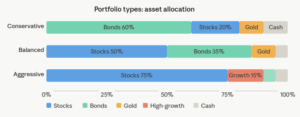
Below is a simplified guide to how these layers might be structured:
| Asset Class | Conservative | Balanced | Aggressive |
|---|---|---|---|
| Stocks / Equity ETFs | 20% | 50% | 75% |
| Bonds | 60% | 35% | 5% |
| Gold / Commodities | 10% | 10% | 5% |
| Cash / Short-term | 10% | 5% | 5% |
| High-growth / Alternatives | 0% | 0% | 10% |
These are not strict rules but starting frameworks. The right allocation depends on your goals, timeline, and how you personally react to market downturns.
Rebalancing: The Maintenance Work Most Investors Ignore
A portfolio that is never rebalanced slowly drifts away from its original design. In a strong equity market, for example, stocks tend to grow faster than bonds. What starts as a 50/50 allocation can quietly become 70/30 without you making any active decision.
That shift matters because it means you are now taking on more risk than you originally intended.
Rebalancing is the process of bringing your portfolio back in line with your target allocation. It involves selling assets that have grown beyond their intended share and buying those that have fallen behind.
Most investors do this once a year, which is usually enough. Others prefer a threshold-based approach, rebalancing whenever an asset class drifts more than five percentage points from its target.
The interesting part is that rebalancing naturally enforces discipline. It pushes you to sell assets that have performed well and buy those that have underperformed. In practice, it means you are systematically selling high and buying low—something most investors struggle to do consistently on their own.
A simpler, lower-friction approach is to use dividends and interest payments to top up underweighted assets. This helps restore balance gradually while avoiding unnecessary transaction costs or tax implications.
Common Mistakes Beginners Make
One of the most common mistakes is over-concentration in familiar companies. Many investors naturally gravitate toward brands they use daily—banks, phone manufacturers, or popular retail companies. While this feels logical, these investments often belong to the same sector and tend to react similarly when the economy shifts.
Another frequent mistake is ignoring fees. On the surface, the difference between an ETF charging 0.05% and another charging 0.95% may not seem significant. But over long periods, those costs compound and can meaningfully reduce total returns. Keeping costs low, especially in the core of your portfolio, makes a real difference over time.
The third mistake is reacting to short-term market movements. A well-diversified portfolio will inevitably lag behind the hottest investments in certain years. That is not a flaw—it is part of the design. The goal is not to win every year, but to achieve steady, sustainable growth over a long investment horizon without being forced to exit during downturns.
Conclusion
Diversification is not complicated, but it does require discipline and honesty about your goals.
Start with your risk tolerance and time horizon. Build a simple structure with three layers: growth, stability, and protection. Choose assets that behave differently from one another rather than simply chasing recent winners. Rebalance regularly to keep your portfolio aligned. And most importantly, avoid the temptation to abandon your strategy when markets get uncomfortable.
Over time, it is not excitement or timing that builds wealth—it is structure and consistency.