Daylight Saving Time 2026: When the clocks change and what it means
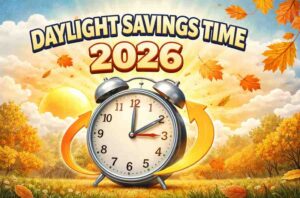
The annual time change is approaching again, and in 2026 most Americans will lose an hour of sleep as clocks “spring forward” this weekend.
For nearly two decades, the United States has followed a routine where clocks are moved forward by one hour on the second Sunday of March to begin daylight saving time.
What is daylight saving time?
Daylight Saving Time shifts clocks forward by one hour, effectively moving an hour of daylight from the morning to the evening. The goal is to provide longer daylight hours later in the day.
For example, according to the National Weather Service, sunrise in Boston on Saturday—the day before the change—will occur at 6:09 a.m., with sunset at 5:41 p.m.
After the clocks move forward on Sunday, sunrise will be at 7:08 a.m., while sunset will shift later to 6:42 p.m.
When does daylight saving time start in 2026?
In 2026, daylight saving time begins on Sunday, March 8, at 2 a.m. local time.
At that moment, clocks will jump forward to 3 a.m.
Since 2007, the start date has been set as the second Sunday in March, according to the United States Naval Observatory.
Before that change:
-
From 1987 to 2006, daylight saving time began on the first Sunday in April.
-
The Uniform Time Act of 1966 had originally established the start date as the last Sunday in April.
During the 1970s energy crisis, the U.S. government even experimented with year-round daylight saving time starting in January 1974. However, the trial ended early, and the country returned to standard time later that year before resuming the normal seasonal schedule.
Do we lose or gain an hour?
When daylight saving time begins in March, Americans lose one hour of sleep as clocks move forward from 2 a.m. to 3 a.m.
This change happens shortly before the March equinox on March 20, which marks the beginning of spring.
When does daylight saving time end in 2026?
Daylight saving time will end on Sunday, November 1, 2026, when clocks “fall back” one hour at 2 a.m. local time, returning to standard time.
By that point, the United States will already be several weeks into autumn following the September equinox on September 22.
According to the National Institute of Standards and Technology, daylight saving time will last 238 days in 2026.
Why does daylight saving time exist?
Daylight saving time was first introduced in the United States in 1918 during World War I to help conserve fuel.
It was used again during World War II for similar reasons, including supporting national defense efforts.
Studies over the years have suggested mixed benefits. The Congressional Research Service has noted modest improvements in areas such as energy use, road safety, and reductions in certain crimes.
Meanwhile, the United States Department of Energy reported that extending daylight saving time in 2007 led to a 0.03% reduction in electricity consumption. However, some research has also linked the time change to temporary health effects and sleep disruption.
Which places do not observe daylight saving time?
Most U.S. states follow daylight saving time, but a few do not.
Hawaii and Arizona do not observe the time change. However, the Navajo Nation within Arizona does follow daylight saving time.
Several U.S. territories also do not change their clocks, including:
-
American Samoa
-
Guam
-
Northern Mariana Islands
-
Puerto Rico
-
United States Virgin Islands
Will my phone update automatically?
In most cases, yes. If your smartphone is set to automatic time updates, it will adjust itself when daylight saving time begins.
Major device makers such as Apple, Google, and Samsung provide support guides for users who need help adjusting their settings. Some mobile carriers also offer instructions for manually updating time settings if needed.