Tinubu Highlights Progress on Renewed Hope Housing Agenda, Mortgage Reforms
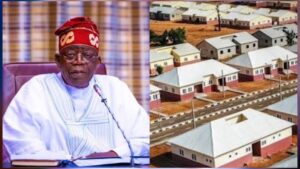
President Bola Ahmed Tinubu has outlined key achievements under the Renewed Hope Housing Agenda, highlighting ongoing housing projects and reforms aimed at expanding homeownership and improving access to mortgage financing across Nigeria.
The President said his administration came into office with a commitment to make decent and affordable housing accessible to hardworking Nigerians who have long struggled with the burden of renting. According to him, the government is now translating those promises into measurable results.
Large-Scale Housing Development Nationwide
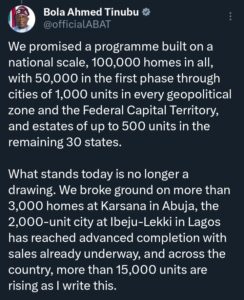
Tinubu disclosed that the national housing programme targets the delivery of 100,000 homes, with 50,000 units planned in the first phase.
The initiative includes the development of 1,000-unit housing cities in each of the six geopolitical zones and the Federal Capital Territory (FCT), as well as 500-unit estates in other states across the federation.
He revealed that more than 3,000 housing units are currently under construction in Karsana, Abuja, while the 2,000-unit estate in Ibeju-Lekki, Lagos State, has reached an advanced stage, with sales already underway.
According to the President, over 15,000 housing units are presently being developed simultaneously in different parts of the country.
Reforms in Land Administration and Construction
Beyond the construction of new homes, Tinubu emphasized that the administration is implementing reforms to strengthen land administration and improve the efficiency of the housing sector.
He said efforts are ongoing to formalise land titles that have remained inactive as “dead capital,” enabling property owners to unlock economic value from their assets. The government is also working to expand formal land registration nationwide.
The President further noted that reforms in equipment leasing are helping contractors gain easier access to construction machinery through improved legal and financial frameworks, reducing delays and boosting project delivery.
To enhance transparency, the government has introduced uniform pricing for housing units and is establishing building materials hubs across the six geopolitical zones to support construction activities and lower costs.
Expanding Mortgage Access and Housing Finance
Tinubu stressed that affordable housing cannot be achieved without accessible financing options.
He disclosed that through the MOFI Real Estate Investment Fund, 1,859 families across 25 states have secured mortgage loans worth approximately ₦128 billion at a single-digit interest rate of 9.75 per cent, repayable over a 20-year period.
The President also highlighted the Family Homes Funds programme, which is targeted at low-income earners and widows. The initiative aims to facilitate the construction of 500,000 homes while creating an estimated 1.5 million jobs nationwide.
Long-Term Strategy for Housing and Economic Growth
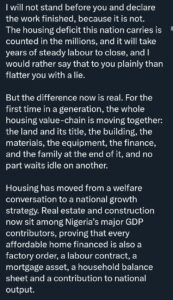
Acknowledging that Nigeria’s housing deficit runs into millions of units, Tinubu noted that the challenge cannot be resolved overnight. However, he maintained that significant progress is being recorded through coordinated reforms across the housing value chain.
He said the administration is integrating land administration, housing construction, building materials supply, equipment access and mortgage financing into a unified system designed to drive sustainable growth in the sector.
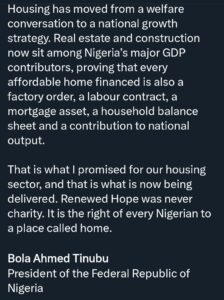
The President added that the real estate and construction industries are increasingly contributing to Nigeria’s economic development, describing every completed home as both a valuable household asset and a catalyst for national growth.