Nigerian Ambassador-designate to Mexico, Reno Omokri, has criticised music star Davido for publicly advocating for the release of schoolchildren abducted in Oyo State, arguing that widespread publicity surrounding such incidents could unintentionally benefit kidnappers and complicate rescue efforts.
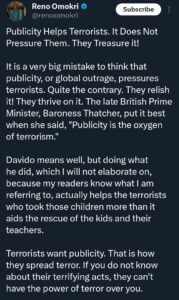
In a lengthy statement released on Thursday, Omokri challenged the popular belief that international attention and public outrage automatically increase pressure on terrorist groups. According to him, terrorist organisations often thrive on publicity because it amplifies fear, extends their influence, and increases the perceived value of their hostages.
While acknowledging that Davido’s intentions were commendable, Omokri maintained that taking the issue to a global audience could ultimately serve the interests of the abductors rather than the victims.
“Publicity Is the Oxygen of Terrorism”
Referencing former British Prime Minister Margaret Thatcher’s famous assertion that publicity is “the oxygen of terrorism,” Omokri argued that terrorist groups rely heavily on public attention to spread fear and achieve their objectives.
According to him, acts of terrorism lose much of their psychological impact when they remain largely unknown. However, once such incidents attract widespread media coverage and international attention, the perpetrators effectively achieve one of their primary goals.
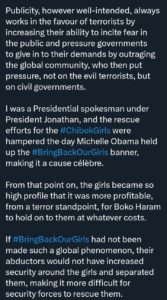
“Publicity, however well-intended, always works in the favour of terrorists by increasing their ability to incite fear in the public and pressure governments to give in to their demands,” he stated.
Chibok Campaign Made Rescue More Difficult, Omokri Claims
Drawing from his experience as a spokesman during the administration of former President Goodluck Jonathan, Omokri argued that efforts to rescue the abducted Chibok schoolgirls became significantly more challenging after the campaign gained global prominence.
He specifically cited the moment former U.S. First Lady Michelle Obama held a #BringBackOurGirls placard, an action that helped propel the campaign onto the international stage.
According to Omokri, once the abduction became a worldwide cause, the girls became more valuable to their captors. He claimed that the increased attention prompted Boko Haram to tighten security around the victims and disperse them across different locations, making rescue operations more difficult.
“From that point on, the girls became so high-profile that it was more profitable, from a terror standpoint, for Boko Haram to hold on to them,” he said.
Security Agencies Already Taking Action
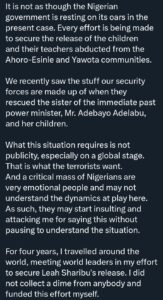
Omokri stressed that Nigerian authorities are actively working to secure the release of the abducted children and teachers from the Ahoro-Esinle and Yawota communities, insisting that security agencies do not require international campaigns to take action.
He pointed to the recent rescue of relatives of former Minister of Power, Adebayo Adelabu, as evidence that security forces are making progress in tackling kidnapping and insecurity.
According to him, what is needed at this stage is a carefully coordinated response rather than global campaigns that could increase the strategic value of the hostages.
Reflects on Campaign for Leah Sharibu
Omokri also revisited his years-long advocacy for the release of Leah Sharibu, one of the schoolgirls abducted by terrorists from Dapchi, Yobe State, in 2018.
He revealed that he personally financed a global campaign aimed at securing her freedom, stating that he received no financial assistance from any individual or organisation.
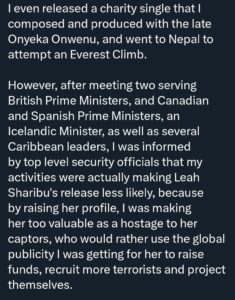
According to him, the campaign took him across several countries, where he met with influential political leaders and government officials. He claimed to have engaged with two serving British prime ministers, the prime ministers of Canada and Spain, an Icelandic minister, and several Caribbean leaders in an effort to garner international support.
He also disclosed that he worked with the late Onyeka Onwenu on a charity single designed to draw attention to Sharibu’s plight and even travelled to Nepal in an attempt to climb Mount Everest as part of efforts to raise global awareness.
Why He Abandoned the Strategy
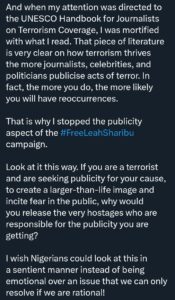
Despite the scale of the campaign, Omokri said senior security officials later advised him that the publicity surrounding Sharibu’s case might actually be reducing the chances of her release.
According to him, the extensive attention had elevated her profile to such a degree that her captors now had greater incentives to keep her in captivity.
He argued that terrorist organisations often exploit international publicity to recruit supporters, attract funding, and project influence.
Omokri said he was particularly influenced after studying a UNESCO handbook on terrorism coverage, which warns about the potential dangers of excessive publicity surrounding terrorist acts.
The publication, he noted, highlighted how extensive media attention can sometimes contribute to the objectives of terrorist groups rather than undermine them.
As a result, he said he eventually abandoned the publicity-driven aspect of the #FreeLeahSharibu campaign.
Calls for a More Rational Approach
Concluding his remarks, Omokri urged Nigerians to approach issues of terrorism and kidnapping with what he described as a rational rather than emotional mindset.
While acknowledging that public campaigns are often motivated by genuine concern for victims, he argued that they can unintentionally strengthen the bargaining power of kidnappers and make rescue efforts more difficult.
Using a hypothetical example, he questioned why a terrorist group would willingly release hostages who are generating global attention and publicity for its cause.
Omokri acknowledged that many Nigerians may disagree with his position but maintained that understanding the dynamics of terrorism requires careful analysis rather than emotional reactions.
His comments have since generated debate online, with supporters agreeing that excessive publicity can complicate security operations, while critics argue that public pressure remains an important tool for demanding accountability and ensuring victims are not forgotten.
Watch the video below…